Welcome to
Counselling Psychology
Learn to support, guide, and empower people through life’s challenges.
Counselling Psychology trains you to provide professional psychological support to individuals, families, and groups. You’ll learn to assess mental health, provide counselling interventions, handle crisis situations, and promote emotional well-being. TVET-CDACC-accredited courses equip you with practical skills, ethical understanding, and communication techniques needed for real-world counselling environments.
Who can apply
| Course Level | Minimum KCSE Grade |
|---|---|
|
Level 5 (Certificate) |
KCSE D (Plain) and above. |
|
Level 6 (Diploma) |
KCSE C– and above |
Course Level
Minimum KCSE entry grade
Level 5 (Certificate)
KCSE D (Plain) and above.
Level 6 (Diploma/Advanced Certificate)
KCSE C– and above
Duration & mode
Level 5 — ~12 months (full-time), combining theory, workshops, and practical attachments.
Level 6 — ~18–24 months, with advanced engineering theory, diagnostics, and management modules.
What you will learn
The TVET CDACC curricula are competency-based and grouped into Basic, Common and Core competencies. Below are representative modules you’ll find in each level (modules and unit titles vary slightly between institutions but follow TVET CDACC occupational standards).
Level 6
• Advanced counselling theories and interventions
• Psychological assessment and testing
• Crisis intervention and trauma counselling
• Research methods, ethics, and evidence-based practice
• Supervision and mentorship in counselling
• Leadership and management in counselling services
• Extended practical placement in clinical or community settings
Level 5
• Introduction to counselling psychology and human development
• Basic counselling skills and techniques
• Communication and active listening skills
• Ethics, confidentiality, and professional practice
• Group and family counselling fundamentals
• Mental health awareness and support strategies
• Supervised practical placement in counselling settings
Career paths & where you can work
• Public and private hospitals (mental health units)
• Schools, colleges, and youth centres
• NGOs and community support programs
• Private counselling practice or corporate counselling services
• Advanced progression: supervisory roles, specialised therapy, or academic teaching
Level 6 graduates are more competitive for leadership roles, specialised counselling, and higher-paying positions.Practical training & attachments
Hands-on experience is key:
• Supervised counselling sessions in hospitals, schools, or community centres
• Group and family counselling practice
• Case studies and role-play simulations
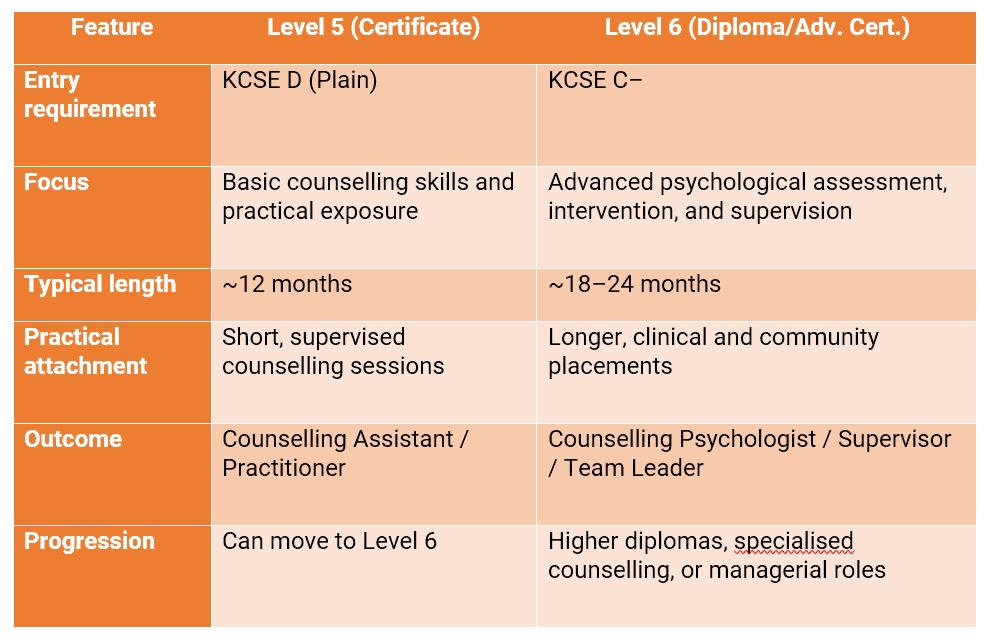
Practical competency is required for certification by TVET-CDACC.Level 5 vs Level 6 Quick Comparison
Ready to join us?
Mortuary Science is a respected career combining skill, professionalism, and empathy. Level 5 prepares you for hands-on mortuary roles; Level 6 equips you for leadership, supervision, and advanced forensic responsibilities.
JOIN US TODAY