Welcome to
Mortuary Science
Mortuary Science trains you to work professionally in mortuaries, funeral services, and pathology labs.
Mortuary Science trains you to work professionally in mortuaries, funeral services, and pathology labs. You’ll learn to handle, preserve, and prepare bodies for viewing or burial, manage mortuary equipment, and support families sensitively. TVET-CDACC-accredited courses ensure you graduate with practical skills, ethics, and knowledge recognized by employers in hospitals, funeral homes, and government agencies.
Who can apply
| Course Level | Minimum KCSE Grade |
|---|---|
|
Level 5 (Certificate) |
KCSE D (Plain) and above. |
|
Level 6 (Diploma) |
KCSE C– and above |
Course Level
Minimum KCSE entry grade
Level 5 (Certificate)
KCSE D (Plain) and above.
Level 6 (Diploma/Advanced Certificate)
KCSE C– and above
Duration & mode
Level 5 — ~12 months (full-time), combining theory, workshops, and practical attachments.
Level 6 — ~18–24 months, with advanced engineering theory, diagnostics, and management modules.
Modes: Full-time, sometimes part-time or modular depending on college.
What you will learn
The TVET CDACC curricula are competency-based and grouped into Basic, Common and Core competencies. Below are representative modules you’ll find in each level (modules and unit titles vary slightly between institutions but follow TVET CDACC occupational standards).
Level 6
• Advanced embalming and preservation techniques
• Management of mortuary facilities and equipment
• Forensic mortuary procedures and pathology basics
• Occupational safety and infection control management
• Record management, ethics, and legal compliance
• Clinical and mortuary attachments under supervision
• Leadership, supervision, and mortuary service management
Level 5
• Anatomy and physiology related to mortuary practice
• Basic mortuary techniques and embalming
• Infection prevention and safety in handling bodies
• Handling mortuary equipment and chemicals
• Documentation, record keeping, and reporting
• Communication with families and grief sensitivity
Career paths & where you can work
• Hospital mortuaries
• Funeral homes and mortuary service companies
• Government and forensic pathology departments
• Crematorium and cemetery management
• Advanced progression: supervisory roles, teaching, or forensic specialization
Level 6 graduates have higher chances for supervisory roles, management, and specialized positions.Practical training & attachments
Practical skills are core:
• Mortuary lab sessions for embalming, body preparation, and chemical handling
• Clinical attachments in hospital mortuaries or funeral homes
• Workplace assessments documenting practical competencies
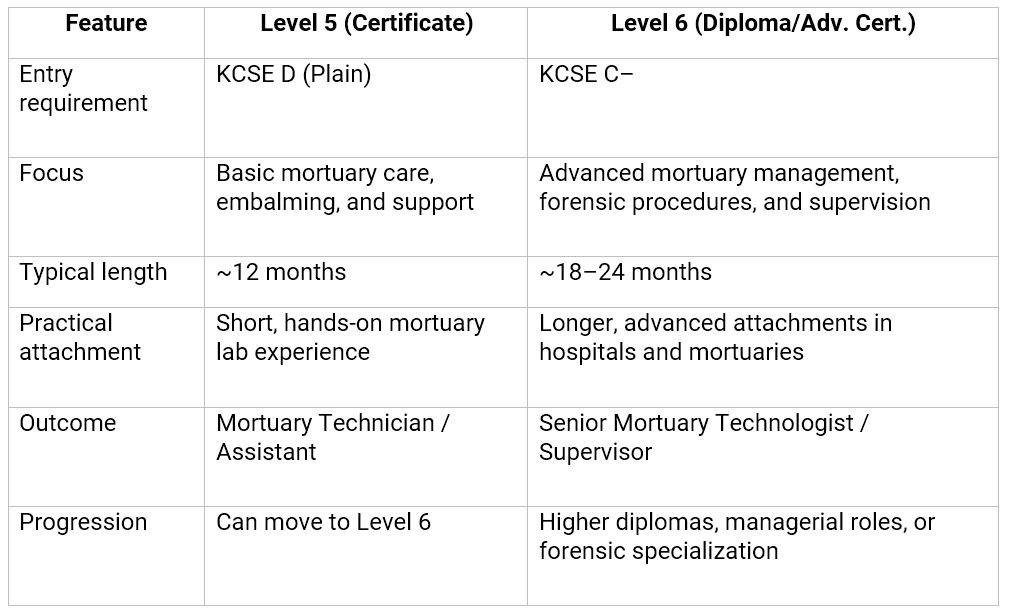
Level 5 vs Level 6 — quick compare
Ready to join us?
Mortuary Science is a respected career combining skill, professionalism, and empathy. Level 5 prepares you for hands-on mortuary roles; Level 6 equips you for leadership, supervision, and advanced forensic responsibilities.
JOIN US TODAY