Welcome to
Social Work — Level
Empower communities, support families, and make a real difference in people’s lives.
Social Work trains you to support individuals, families, and communities facing social challenges. You’ll learn to assess needs, provide counselling and guidance, advocate for vulnerable groups, and implement community programs. TVET-CDACC-accredited courses equip you with practical skills, ethical understanding, and communication techniques to work effectively in social services, NGOs, and government programs.

Who can apply
| Course Level | Minimum KCSE Grade |
|---|---|
|
Level 5 (Certificate) |
KCSE D (Plain) and above. |
|
Level 6 (Diploma) |
KCSE C– and above |
Course Level
Minimum KCSE entry grade
Level 5 (Certificate)
KCSE D (Plain) and above.
Level 6 (Diploma/Advanced Certificate)
KCSE C– and above
Duration & mode
Level 5 — ~12 months (full-time), combining theory, workshops, and practical attachments.
Level 6 — ~18–24 months, with advanced engineering theory, diagnostics, and management modules.
Modes: Full-time, sometimes part-time or modular depending on college.
What you will learn
The TVET CDACC curricula are competency-based and grouped into Basic, Common and Core competencies. Below are representative modules you’ll find in each level (modules and unit titles vary slightly between institutions but follow TVET CDACC occupational standards).
Level 6
• Advanced social work theories and interventions
• Policy analysis and community program design
• Crisis intervention and trauma support
• Leadership and supervision in social work
• Research, monitoring, and evaluation of social programs
• Extended practical placement in government, NGO, or community projects
• Ethics, advocacy, and human rights in practice
Level 5
• Introduction to social work and human development
• Community engagement and assessment
• Counselling and support techniques
• Ethics, confidentiality, and professional practice
• Family, child, and group social work
• Social policy and welfare systems
• Supervised practical placement in social service settings
Career paths & where you can work
• Public and county social service departments
• Non-governmental organizations (NGOs) and community-based programs
• Schools, youth centres, and hospitals
• Policy advocacy and program management roles
• Advanced progression: supervisory roles, specialised social work, or teaching positions
Level 6 graduates are better positioned for leadership roles, project management, and specialised social services.Practical training & attachments
Hands-on experience is essential:
• Supervised fieldwork in communities, NGOs, or government programs
• Group work, family support, and individual counselling practice
• Case studies, advocacy projects, and role-play simulations
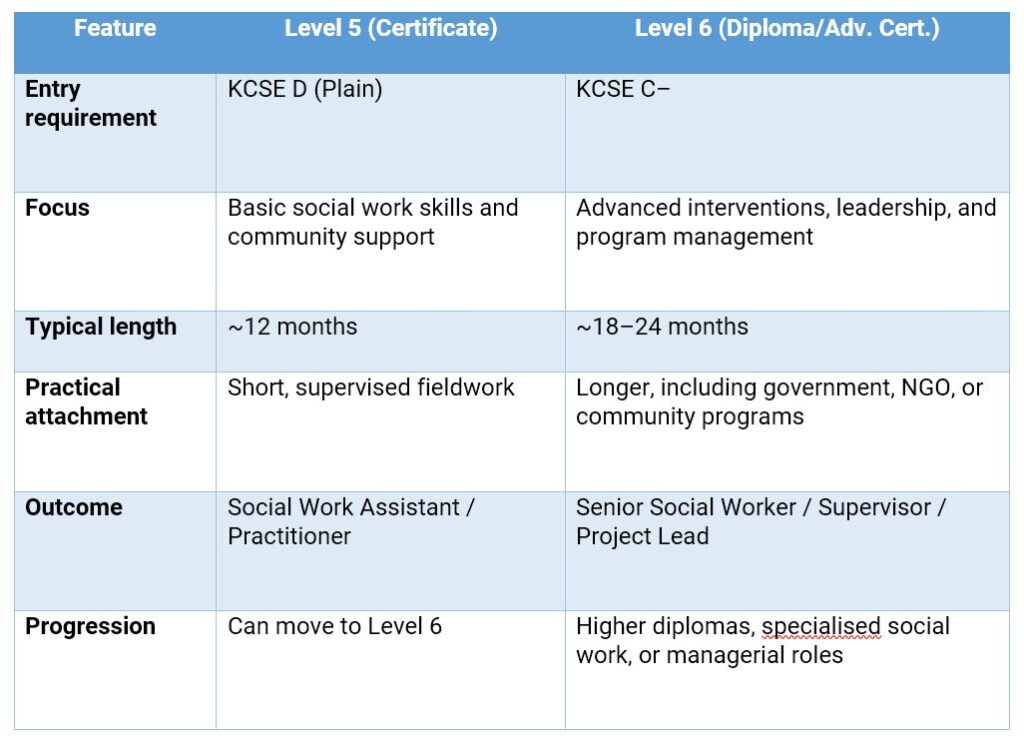
Level 5 vs Level 6 Quick Comparison
Ready to join us?
Social Work is a fulfilling career that combines empathy, skill, and impact. Level 5 prepares you for practical community and social work roles; Level 6 equips you for advanced interventions, leadership, and program management.
READY TO STAERT LEARNING?